·
2 min read
Grain Size Analysis: A Universal Automated Method for ASTM E112


In many manufacturing processes, accurate grain size measurement from metallographic images is essential. Grain size directly influences a material's mechanical properties — strength, ductility, toughness, and fatigue resistance — making it a cornerstone of quality control in metals, aerospace, automotive, and electronics industries.
The primary standard governing grain size measurement is ASTM E112, complemented by ASTM E930 and ASTM E1382. Together they define intercept, intersection, and planimetric methods for quantifying grain size in a reproducible, auditable way.
Despite decades of progress in image analysis, conventional automated methods often struggle with real-world samples. Common metallographic imperfections — twins, compression slip lines, over- or under-etching, scratches, and background noise — are enough to defeat rule-based segmentation algorithms tuned for ideal conditions.
The result: analysts must intervene manually, adjust parameters sample by sample, or accept unreliable results. None of these outcomes is compatible with a modern quality control workflow.
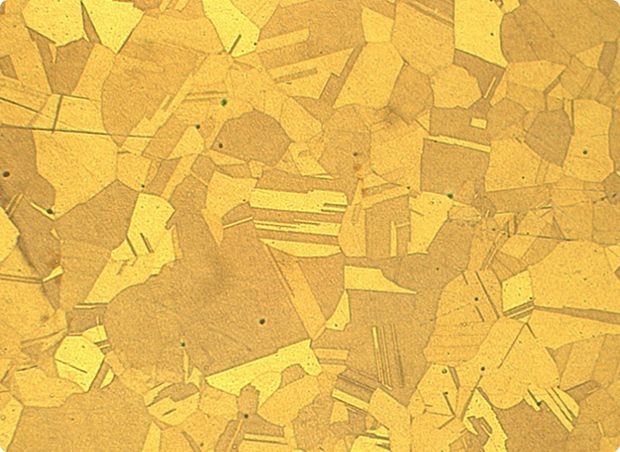
Twinned copper alloy microstructure: a classic case where conventional automated methods fail. The AI plugin handles it reliably.
Clemex's AI-powered grain size solution changes the equation. Rather than requiring per-sample parameter tuning, it applies a single, validated method across a wide range of microstructures and materials — truly plug-and-play.
The algorithm is validated by experts at the National Research Council Canada for metallography, and supports all measurement methods defined in the ASTM E112 standard.
One method for different materials. Copper alloys, austenitic steels, titanium alloys containing twins, and dendritic grains in aluminum are all recognized and correctly measured.

Cast aluminum imaged with polarized light and a lambda plate. Dendritic and color-differentiated grains are recognized automatically.
With the AI plugin, segmenting even the most difficult twinned images is fast and reliable. Twins are recognized and correctly excluded from grain boundary detection — no manual intervention required.
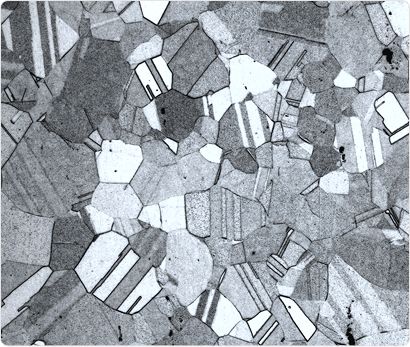
Twinned microstructure correctly segmented. Twin boundaries are identified and excluded from grain size calculations.
When etching is incomplete, grain boundaries appear as dotted or faint lines. The AI correctly segments these boundaries while ignoring twins and common deformation artifacts.
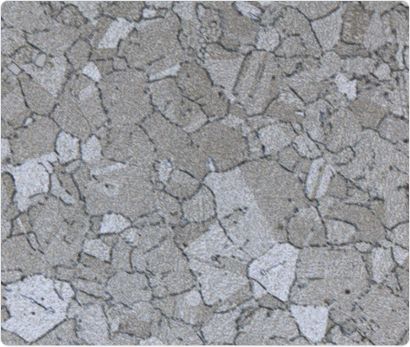
Under-etched sample: dotted grain boundaries are recognized and accurately segmented.
Compared to conventional approaches such as the comparison chart or the circular intercept method, the AI plugin is more accurate, more reproducible, and dramatically faster. Scan any sample with the same method and export results in just a few seconds.

Automated ASTM E112 report: grain size rating, distribution histogram, and field-to-field statistics — generated in seconds.
The solution covers the full range of microstructure types encountered in industrial metallography:

No visible grain boundaries: martensitic steel after heat treatment, and exotic non-ferrous metals such as NiTiNol (shape-memory titanium/nickel alloy).

Medium-carbon ferrite/pearlite: a special Clemex algorithm distinguishes pearlite from ferrite in a single step, despite intensity variation between the two phases.

Austenitic steel: etching stains are automatically detected and excluded from grain size measurements.

Solid grains with various grey levels: aluminum alloy or pure titanium viewed in polarized light without a lambda plate.

Light grains with dark outlines: austenitic, ferritic, or prior-austenitic grain structures.

Elongated grains from cold-rolled steel.
The Grain and Cell Size Application Package measures grain intercept, intercept counts, intersection counts, grain boundary length, and grain areas — all in conformance with ASTM E112, ASTM E930, and ASTM E1382, with validation using the Heyn method.
The segmentation algorithm is validated by experts at the National Research Council Canada for metallography — providing the confidence needed for audit-ready, compliance-grade reporting.

A single method across dozens of microstructure types — from copper and titanium alloys to cast aluminum and cold-rolled steel.
Grain size analysis no longer needs to be a bottleneck. With an AI-powered universal method, laboratories can achieve consistent, audit-ready results across the full range of microstructures they encounter — without the manual intervention, parameter tuning, or subjectivity that traditional methods require.

Stop relying on inaccurate legacy methods. Learn how AI transforms grain size analysis and ensures materials meet strict ASTM E112 standards.

Recent advances in artificial intelligence have given the possibility for image analysis to be simplified. Learn how by reading this white paper.
How grain refinement improves the strength and ductility of aerospace aluminum alloys, and how automated image analysis quantifies grain size.
Help us make clemex.com better. We use cookies to understand how the site is used so we can improve it for you — they're optional, and you can decline. See our Privacy Policy.