·
5 min read
Automated analysis of laser grooves on wafers


Advances in laser grooving mean that manufacturers are able to optimize die separation quality by combining traditional blade dicing and laser grooving techniques to separate individual chips from the silicon wafer. However, it is still a costly use of time, as the groove must be visually inspected by a microscope operator, which also introduces individual dependencies. Using the Clemex Vision microscopy system, Clemex has demonstrated a new automated process that reduces the technician time spent analyzing the die, while at the same time improving the accuracy of the measurement.
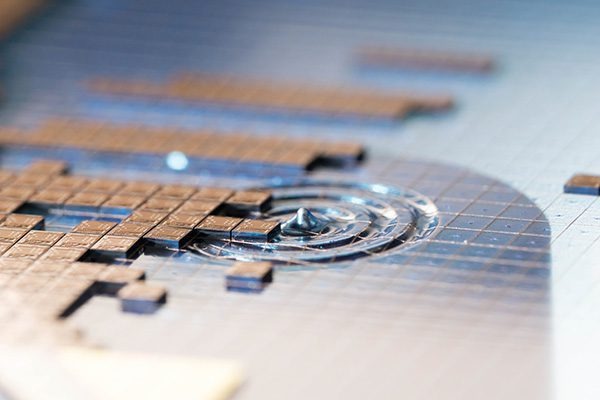
Multiple dies arranged on a silicon wafer.
Ever since silicon wafers have been set up to accommodate multiple dies, there has been the problem of the safe and uniform removal of the dies. The traditional technique has been to use an extremely sharp blade to saw through the wafer around the die streets, leaving a buffer of material and the die in the centre.
However, there are some problems with blade dicing, mainly that, however sharp the blade, it can still introduce stresses into the die and the wafer as a whole. It is widely recognized that defects are introduced into the wafer as a result of the grinding and shearing mechanism of the saw cutting the wafer. These defects can induce passivation and metal-layer peeling, chipping, cracks, and interlayer dielectric (ILD) delamination, all of which must be avoided to ensure a stable device.
In an effort to avoid these issues, manufacturers have had to adopt an alternative method to achieve high-quality processing with minimal delamination on the wafer prior to die separation: laser grooving. This provides a precut that reduces stresses and can be visually inspected to ensure correct placement. Blade dicing can then be used to make the final cut if the precut line passes.
Laser grooving is a thermal-energy-based process, and there is no direct tool-to-workpiece contact. It uses a focused high-energy laser to transfer thermal energy to the wafer, which is absorbed by the topmost low-thermal-energy ILD metal layers. These metal layers then heat up, melting and vaporizing, and the molten and vaporized material can be removed by a directional flow of air. There is now a substantial groove in the wafer, which is thinner and much less resistant to the blade dicing process, resulting in cleaner removal of the die.

After laser grooving, blade dicing makes the final cut through the weakened groove.
Laser grooving is therefore now the primary choice for manufacturers looking to improve the quality of wafer dicing. But even this process is not free from drawbacks. The laser itself is a complex system that needs to be positioned and repositioned accurately over the wafer to ensure it grooves along the correct point. The groove itself must be extremely precise and conform to the shape and tolerance set by the manufacturer. A groove that does not meet this tolerance can result in an improperly cut die, which is not fit for use and must be discarded. A significant amount of time must be spent by an operator using a microscope to analyze the tolerances of the grooves and clear them for dicing.

Automated pass/fail assessment of a laser groove against the required tolerance.
Using the Clemex Vision microscope system, Clemex has developed a new method of automating the analysis of the distance between the groove and the edge of the die.

Close-up inspection of a wafer under the microscope.
First, the wafer is correctly positioned under the lens. This is done by using a reference point and then adjusting the whole wafer so it is correctly oriented. Once this is achieved, each of the dies at the extremities or centre points of the wafer can be correctly analyzed.

Aligning and orienting the wafer using reference points.
After analysis of the reference points, the laser groove itself can be analyzed. This is done by using a reference line that has been drawn around the die, and measuring the mean distance from this line to the groove itself. As this distance can vary slightly, a mean distance ΔD is taken.

Measuring the mean distance ΔD between the reference line and the groove.
To get an overall mean distance, the absolute distance of the north edge of the die is subtracted from that of the south edge to form a difference of distances: ΔD1. The same procedure is applied to the east and west edges to get ΔD2. ΔD values closest to 0 are best, with tolerances that form a pass/fail threshold.
If either ΔD1 or ΔD2 is above the tolerance required to remove the die, then the laser grooving process needs to be reviewed. The grooving process hasn't worked as intended, and the die cannot be removed unscathed.
This process is repeated for all of the dies on the wafer, all while working within a time constraint, with the analysis a success thanks to the extreme customizability afforded by Clemex Vision. The entire program makes use of conditional statements, automatic centering, moving from target to target, and getting a clear and focused image from large distances. This can be tricky to do when the silicon wafer is up to 12 inches in diameter.
Currently, chip manufacturers are relying on human operators to manually move around the wafer and visually assess the tolerance. This process is incredibly time-consuming and prone to human error, but there hasn't been any alternative until now. The process described here, using Clemex Vision's excellent suite of features, means that manufacturers are finally able to automate their analysis of laser grooving placement on a silicon wafer.
References
Help us make clemex.com better. We use cookies to understand how the site is used so we can improve it for you — they're optional, and you can decline. See our Privacy Policy.