
Automated Inclusion Rating
Clemex CIR helps quality control laboratories vastly improve their productivity by analyzing inclusions in steel with impressive speed, accuracy and repeatability.
Very simple to operate, the inclusion rating software will allow you to reduce analysis time to less than 3 minutes for a 160 mm² area with minimal user intervention.
Enhanced Reviewing Capabilities
Improve your decision-making process by gaining insights into your data. With the latest version of Clemex CIR you can sort, filter and export measurements of each inclusion, thus obtaining meaningful details about your sample.
Types of analysis
Our automated image analysis system is designed to detect the following inclusions and rate them according to most recognized standards: sulfides, aluminates, silicates, globular oxides, single globulars, borides, carbides, nitrides, and carbonitrides.
| ASTM E45 Methods A, C, D, E | Standard Test Methods for Determining the Inclusion Content of Steel |
|---|---|
| ISO 4967 Methods A, B | Steel – Determination of content of non-metallic inclusions – Micrographic method using standard diagrams |
| DIN 50602 Methods M, K | Metallographic examination; microscopic examination of special steels using standard diagrams to assess the content of non-metallic inclusions |
| JIS G 0555 | Microscopic testing method for the non-metallic inclusions in steel |
| EN 10247 | Micrographic examination of the non-metallic inclusion content of steels using standard pictures |
Key features
Clemex CIR Inclusion rating software

Easy data sorting
Take advantage of the most efficient data browser on the market. All detected inclusions can be sorted, filtered and validated within seconds allowing you to focus on critical data.

Map of entire sample
Locates and maps inclusions of the entire sample area, aligned vertically or horizontally. Worst fields are identified rapidly and artifacts can be removed. Operators navigate from one sample to the other with ease.
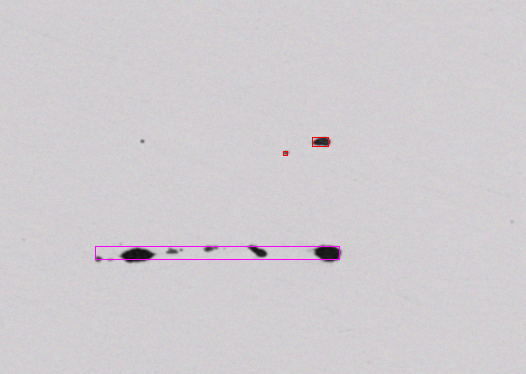
Traceable objects
Select inclusions and artifacts on a map of the entire sample. Toggle between this map view and the selected objects to accept, reclassify or reject them.
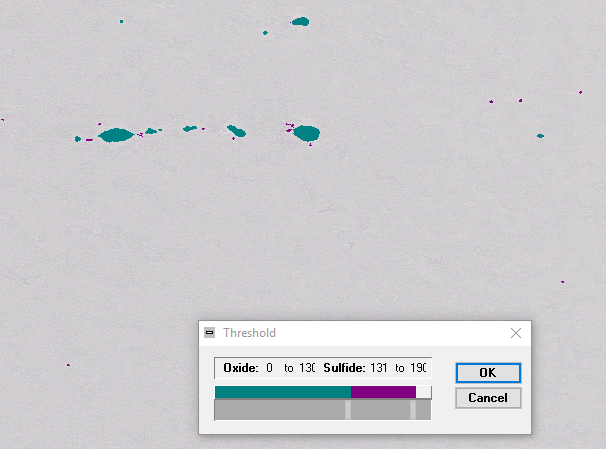
Classify oxides and sulfides
Adjust the thresholding to detect oxides and sulfides accurately. Eliminate fine artifacts and scratches.

Floating worst fields
ASTM, ISO or DIN worst fields are identified automatically. Worst fields are displayed on the sample map using colors that correspond to inclusion types.
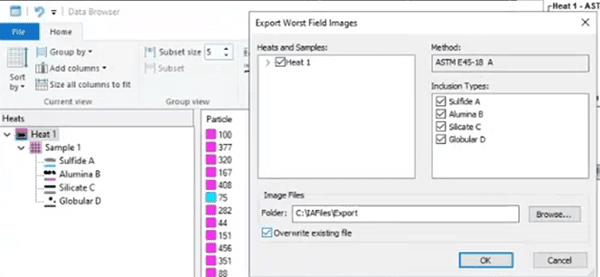
Save images of worst field
Automatically export worst field .tiff images showing detection. This greatly saves time when creating reports for the ASTM E-45 Method A standard.
More Features
DIFFERENT HEATS Analyze up to 6 heats with 6 samples each during the same run.
EXTREME VALUE ESTIMATION Statistically characterize the distribution of the largest inclusions using results of up to 4 trials according to ASTM E-2283.
IMAGE OPTIMIZATION Auto-focus, auto-exposure and automated shading correction.
LARGE INCLUSIONS Long inclusions that span across several fields are detected and measured as one inclusion.
MULTI-PLATE SAMPLES Interfaces between stacked samples are ignored.
RELOAD PATTERNS Save time by placing samples on a magnetic stage plate and reuse previously saved patterns.
REPORTING Save results in many formats including xls, txt, csv, and ASCII for post-processing.
SAVE IMAGES Images captured during an analysis can be saved for further use.
Product details

Typically, an inverted Nikon microscope, a motorized Märzhäuser stage, and a high resolution camera are selected to fit your specific inclusion rating needs. We ensure a seamless integration of all components.
-
Analysis of your needs by a technical representative
-
Configuration, fine-tuning, and calibration
-
On-site installation and training of your team

Increase productivity in a high throughput lab using a very simple workflow. The operator follows a 3-step procedure to obtain repeatable results:
-
Position a sample on the stage
-
Start an analysis on the sample
-
Review data and export results
Hardware & Accessories

Stage Accessories & Sample Holders
Clemex designs and manufactures sample holders and stage adapters, produced to meet any customer specifications for image analysis applications.
Learn more
Microscopes
Clemex distributes Nikon and Leica metrology microscopes across the Americas and Europe, enabling accurate, repeatable microscopic analysis.
Learn more
Microscope Stages
Märzhäuser-Wetzlar stages, controllers and joysticks work with many different brands of microscopes and are fully controlled by our software.
Learn more